
WHAT CAN WE LEARN FROM NERC'S NEW WINTER RELIABILITY ASSESSEMENT?


The North American Electric Reliability Corporation (NERC) is the entity tasked by Congress with ensuring the reliability of the grid. NERC’s summer reliability assessment, issued last May, showed that four large regions, covering all or part of 23 states, were facing an “elevated” risk of blackouts during “extreme conditions” due to inadequate generation capacity.[1] This was big news, and was widely discussed in the media, including by me in my Substack. Luckily, however, the extreme conditions specified by NERC did not materialize and there were no widespread blackouts.
This past November NERC issued its reliability assessment for the upcoming winter.[2] This winter assessment again shows that some regions face an elevated risk of blackouts. But NERC’s conclusion that blackouts could be possible this winter has not been featured as prominently as NERC’s assessment for the summer. Perhaps it’s because, despite NERC’s warning, there were no blackouts this past summer, making NERC’s winter assessment seem less urgent. Whatever the reason, there are some interesting details in the winter assessment I think are worth sharing in this post.
First, I want to point out what I think is the most important and troubling point of the analysis. NERC notes that the total amount of the grid’s generation capacity has increased by 9.4 gigawatts since last winter. This sounds encouraging, given that the grid needs new capacity. However, NERC also notes that, at the same time, the peak demand for electricity has risen by 20 gigawatts.[3] In other words, demand for electricity in the winter has grown over twice as much as the supply of generation capacity. This trend is not sustainable. NERC’s forecast for this coming winter is that blackouts are possible only under extreme conditions. But if demand keeps rising twice as high as supply, then blackouts will be possible, or even likely, under normal conditions.
What does NERC mean by an “elevated risk” of blackouts? As NERC explains, when there is an elevated risk of a blackout in a region, that region should have adequate capacity under normal conditions. However, “resources will not be sufficient to meet operating reserves under extreme peak-day demand with normal resource scenarios (i.e., typical or expected outage and derates)”; or “under normal peak-day demand with reduced resources (i.e., extreme outage and derate scenarios).”[4] In other words, there is a potential for blackouts either if cold weather causes the demand for electricity to be much higher than expected or if the weather causes much higher than expected outages of generation facilities.
I should note that, at the time NERC issued its assessment, projections were that this winter would be slightly warmer than last year.[5] Today, however, the country is in the middle of a cold spell with lower than normal temperatures projected to last as long as a month. The extreme weather conditions that NERC believes could cause blackouts may not be as unlikely as NERC thought they were at the time it issued its assessment.
As I mentioned, NERC found an elevated risk of blackouts this winter for several regions of the US. However, the potential for blackouts affects fewer states and mostly different regions than the ones FERC determined were at an elevated risk last summer. The following map from NERC’s assessment shows where NERC thinks problems might arise this winter.
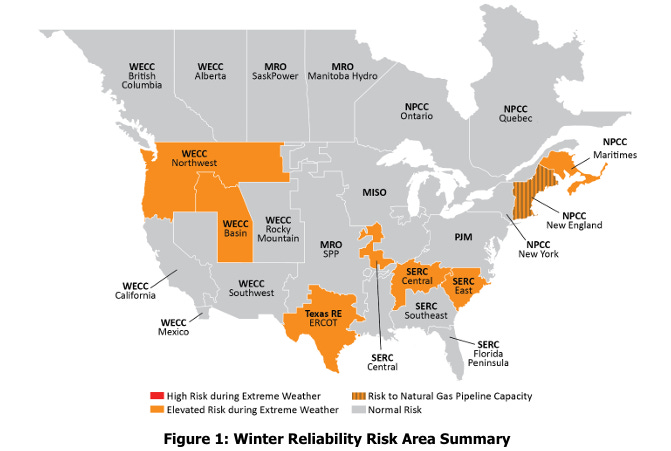
Unlike this past summer, NERC does not predict an elevated risk of blackouts in the MISO or SPP Regional Transmission Organizations (RTOs) this winter, which cover a significant swath of the middle of the country. Instead, the regions NERC believes could potentially be affected are located in the Southeast, in the Pacific Northwest and inland West, and in Texas. Of these regions, only Texas was identified as having an elevated risk of blackouts this past summer. In addition, NERC shows a potential problem in New England resulting from a “Risk to Natural Gas Pipeline Capacity.” The reasons NERC provided for concluding there is an elevated risk of blackouts vary from region to region. I think these reasons provide some useful insights into grid operations, so I will go through them briefly.
Texas-ERCOT. Even though the highest (peak) demand in Texas occurs in the summer, high demand from new data centers and other industrial customers is also increasing the demand for electricity in the winter. NERC notes that the winter peak demand periods in Texas occur before sunrise and after sunset. This is a problem because there is significant solar generation in Texas, but solar panels produce no electricity during these peak hours when the sun is down. NERC also notes that batteries have been constructed in Texas that help store electricity produced by solar generators during the day for use at night. However, the around-the-clock operations of data centers extend the length of the peak demand periods and, as a result, “maintaining sufficient battery state of charge will become increasingly challenging for extended periods of high loads, such as a severe multi-day storm like Winter Storm Uri.”[6]
New England. NERC determined that New England has an adequate amount of generation capacity for this winter. New England’s problem instead is a potential shortage of the fuel needed to supply that capacity. New England relies heavily on natural gas-fired generation and, as NERC notes, there is only limited natural gas pipeline capacity available to transport gas into New England. On extremely cold winter days, much of the pipeline capacity is needed to transport gas used for residential heating purposes. On these days, sometimes there is not enough pipeline capacity left to supply all the gas needed to fuel natural gas-fired generation facilities in the region.
To address this problem, many natural gas generation facilities in New England are equipped to use oil as fuel when natural gas is not available. New England’s reliance on oil-fired generation to meet its winter peak demand is ironic. Oil is much dirtier than natural gas, emitting significantly more carbon dioxide, sulfur dioxide, and nitrogen dioxide. Nevertheless, large amounts of oil must be used to generate electricity in the winter in New England because environmental opposition has killed all proposed new gas pipelines in the region.
NERC is focused on reliability, not the environment. Consequently, in its winter assessment, NERC found that the use of oil as a backup fuel should be adequate to prevent blackouts this coming winter. NERC notes, however, that on very cold days when demand for electricity is highest, the amount of oil stored by generation facilities can be rapidly depleted.[7] This could be a potential problem when there is an extended cold snap, and it is not possible to refill the facilities’ storage tanks with more oil.
SERC East (South Carolina and portions of neighboring states). NERC explains that the potential problem in SERC East is similar to that in Texas. As in Texas, there is no solar power output to meet high demand for electricity in SERC East in the early morning hours.[8]
Remaining Regions. The remaining regions identified by NERC as having an elevated risk of blackouts all have a similar potential problem. NERC’s analysis shows that each of these regions might not have sufficient capacity to supply extremely high winter demands on cold days. In that event, they would be dependent on imports of electricity from neighboring regions. There may not be sufficient amounts of electricity available in the neighboring regions, however, if those regions likewise are facing extreme cold weather conditions.
There are two other aspects of NERC’s winter assessment that I found interesting. First, NERC noted that ERCOT and MISO have implemented new methods for determining the capacity contributions of wind turbines, resulting in a significant reduction (14.2 gigawatts) in the amount of capacity provided by wind turbines in the winter.[9] Wind turbines can provide significant amounts of low cost electricity, but it is much more difficult to forecast when wind generators can produce electricity than it is for solar power. This reduction in the calculation of wind capacity highlights the problem of relying on wind to supply electricity during peak demand periods when wind turbines are not paired with batteries.
Second, of the 9.4 gigawatts of new generation capacity NERC determined was added to the grid’s generation capacity since last winter, only 3.2 gigawatts was thermal or hydroelectric capacity; the remainder was solar power, batteries, and demand response.[10] It is not my intention to turn this post into a discussion of the relative merits of different kinds of generation facilities, but in my view the NERC winter assessment shows that these other types of capacity are not as well-suited as conventional generation capacity for supplying peak demand in the winter:
(1) Solar power is useful for meeting peak demand for electricity in the summer months because solar panels produce the most electricity on the hot days where demand is highest. However, NERC found that winter peak demand occurs when the sun is down and solar panels produce no electricity in those hours;
(2) Demand response, in which consumers agree to cut their use of electricity when so directed, is less likely to be effective in extreme cold conditions. Some industrial consumers may be willing to cut their use of electricity during these conditions by shutting down their operations, but residential consumers may be reluctant to do so; and
(3) Batteries are effective, but as NERC noted, it may be difficult to keep batteries charged during extended cold snaps when all electricity produced is needed to supply consumer demand and there is little excess electricity production that could be used to charge batteries.
I think that the grid needs more conventional thermal, hydroelectric and nuclear capacity, and cannot rely solely on renewables, batteries, and demand response to meet the explosion in demand the grid currently faces, especially in the winter.
What is the main conclusion to be learned from NERC’s Winter Reliability Assessment? I think it is that, even if it turns out all demand for electricity is met this winter, that would not mean there is no winter resource adequacy problem for the future. The analysis provided by NERC shows both that the grid will be living on a knife’s edge this winter and that increases in demand for electricity continues to outstrip the increase in generation capacity. NERC’s assessment confirms the urgent need to rapidly expand the grid’s generation capacity.
In accordance with my current monthly publication schedule while I work on my book, my next post will come out some time in the middle of January. I hope that, in the interim, you all have a great Christmas and a good new year.
***
I hope you enjoyed this post. I enjoy writing them and will never charge for subscriptions or ask for donations. I only ask that, if you did enjoy it, you press the “like” button below. And please consider sharing my posts with other people you think might be interested. Doing so will help me evaluate interest in the book I am writing on grid operations. Of course, if you have a reaction to, or question about, this post, please leave a comment and I will be happy to respond.
[1] NERC, 2025 Summer Reliability Assessment (May 2025).
[2] NERC, 2025-2026 Winter Reliability Assessment (November 2025).
[3] Winter Assessment at 5.
[4] Winter Assessment at 11.
[5] Winter Assessment at 10.
[6] Winter Assessment at 6.
[7] Winter Assessment at 5.
[8] Winter Assessment at 6.
[9] Winter Assessment at 8.
[10] Winter Assessment at 8.
Thanks Matt, so well written and timely. Happy Holidays to you as well